
CMS CY 2027 Proposed Medicare Payment Rules: What Infusion Providers Should Know
COMPLIANCE CORNER WITH IPA
The Centers for Medicare & Medicaid Services (CMS) recently released its proposed Medicare payment rules for Calendar Year (CY) 2027, including proposed changes under the Medicare Physician Fee Schedule (PFS) and Hospital Outpatient Prospective Payment System (OPPS).
For community-based infusion providers, the most significant proposals involve changes to physician office drug administration payments under the PFS and a widening disparity between payments to physician offices and freestanding infusion centers and payments to hospital outpatient departments (HOPDs).
Proposed Reductions to Physician Office Drug Administration Payments
Under the CY 2027 PFS proposed rule, CMS proposes a non-qualifying Alternative Payment Model (APM) conversion factor of $32.84, 1.68% below the CY 2026 conversion factor of $33.40. Although non-qualifying APM clinicians are scheduled to receive a 0.25% statutory update for CY 2027, the temporary 2.5% increase that applied in CY 2026 expires at the end of the year, contributing to the proposed year-over-year decline in the conversion factor.
More significantly for infusion providers, several drug administration codes would experience proposed payment reductions. The Medicare PFS payment rate for CPT code 96413, which covers the first hour of complex intravenous drug administration, would decrease from $133.27 in 2026 to $124.46 in 2027, a 6.6% reduction. CPT code 96365, for the first hour of a therapeutic intravenous infusion, would decrease from $67.13 to $63.38, a 5.6% reduction.
Proposed Medicare PFS Drug Administration Payment Changes
| Code | CY 25 Rate | CY 26 Rate | CY 27 Proposed Rate | % Change CY 26 – CY 27 |
|---|---|---|---|---|
| 96413: Chemo admin; Intravenous Infusion; Up to 1 Hour | $119.36 | $133.27 | $124.46 | -6.6% |
| 96415: Chemo admin; Intravenous; Each additional Hour | $25.55 | $28.39 | $27.91 | -1.7% |
| 96365: Intravenous infusion for therapy; Up to 1 Hour | $57.90 | $67.13 | $63.38 | -5.6% |
| 96372: Therapeutic prophylactic, or diagnostic injection | $13.91 | $15.36 | $15.10 | -1.7% |
Rates shown reflect national CMS payment rates before applicable geographic and other payment adjustments.
The larger reductions for codes 96413 and 96365 appear to be driven in significant part by a broader CMS proposal to overhaul the methodology used to calculate practice expense (PE) relative value units (RVUs). CMS proposes to phase out the Indirect Practice Cost Index (IPCI), which has historically been used to account for specialty-level indirect practice expenses, and replace it with a revised methodology.
The change would be phased in over two years, beginning in CY 2027. CMS has also proposed a stabilization policy that would generally limit annual changes in a code’s PE RVU to plus or minus 5%. Importantly, however, the 5% cap applies to the PE RVU, not the code’s total payment rate, and other adjustments may cause the ultimate change to exceed 5%.
This is particularly relevant for specialties that commonly furnish infusion therapies. Analysis of CMS’s proposed IPCI changes indicates that medical oncology, hematology/oncology, and infectious disease are among the specialties likely to be most affected by the revised methodology.
A Growing Site-of-Service Payment Disparity
The proposed PFS reductions are particularly notable when compared with proposed payment changes for the same drug administration services in hospital outpatient departments. For CPT code 96413, CMS proposes to reduce the physician office payment from $133.27 in 2026 to $124.46 in 2027, a 6.6% reduction, while the corresponding HOPD payment would increase 9.3%, from $337.46 to $368.83. Under the proposed 2027 rates, Medicare would therefore pay nearly $250 more for the first hour of a complex infusion furnished in an HOPD than in a physician office or freestanding infusion center.
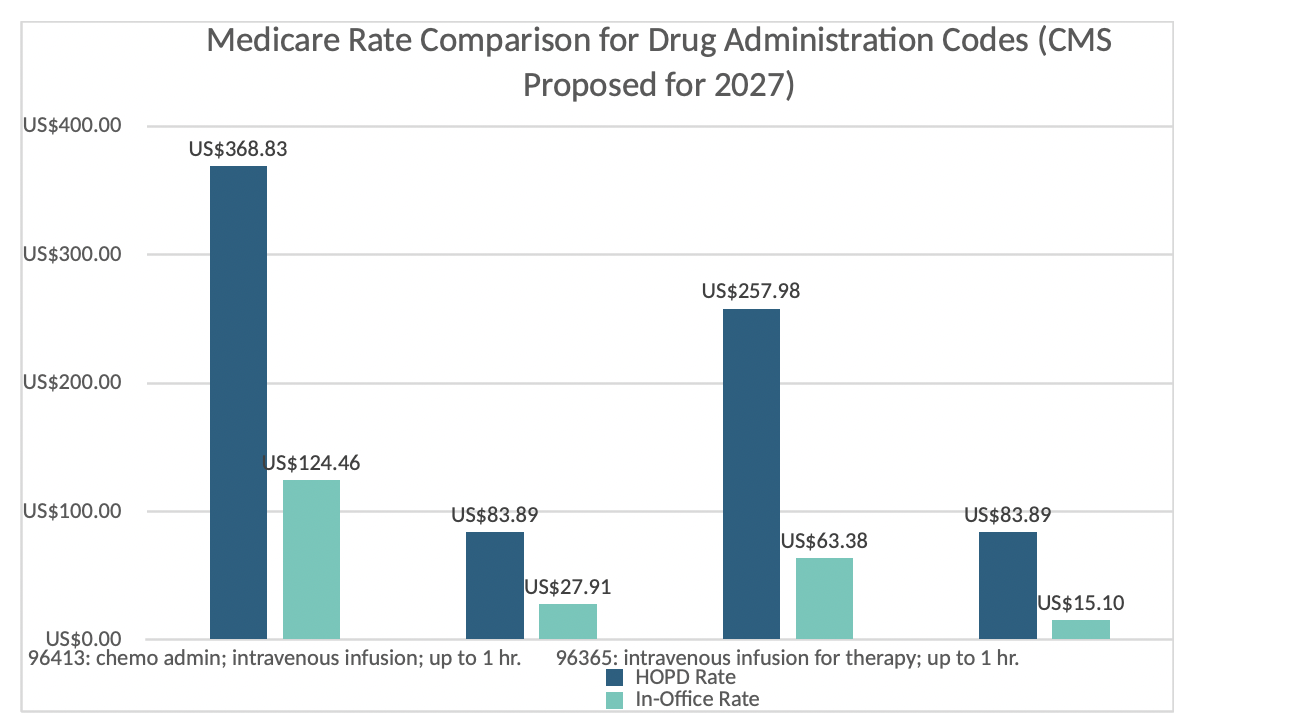
Rates shown reflect national CMS payment rates before applicable geographic and other payment adjustments.
This continues a longer-term divergence in drug administration reimbursement between the two sites of care. For code 96413, the physician office payment was approximately 47.9% of the HOPD payment in 2015. Under the proposed 2027 rates, it would be approximately 33.7%.
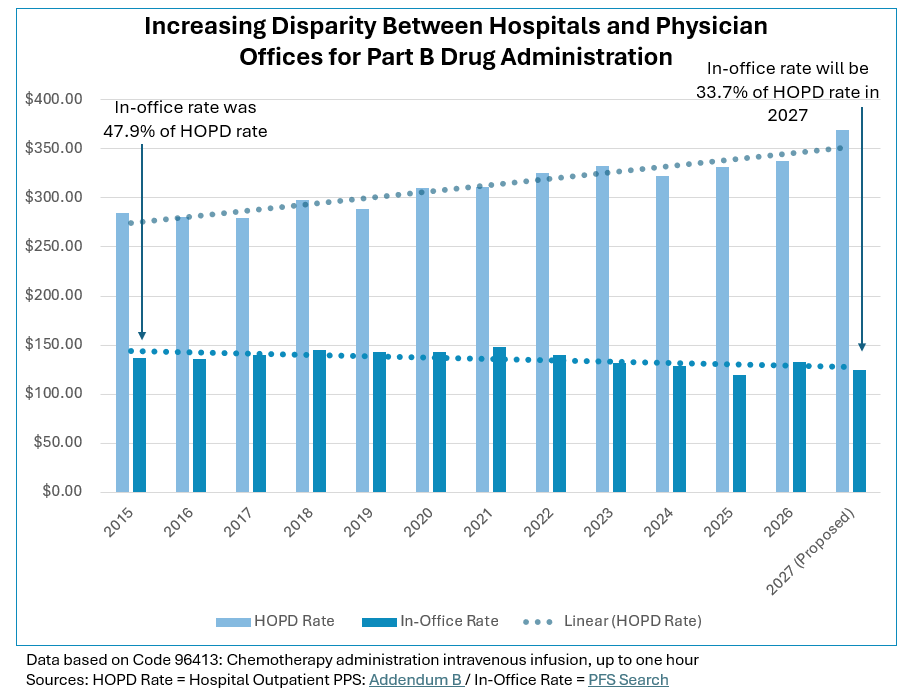
The proposed OPPS rule contributes to this widening gap. CMS proposes to reduce reimbursement for drugs acquired through the 340B Drug Pricing Program from ASP plus 6% to ASP minus 33.4%, based on hospital drug acquisition cost survey data. Because the proposed 340B payment reduction is required to be implemented on a budget-neutral basis, CMS proposes to redistribute those savings through increased payments for other hospital outpatient services, including drug administration. This budget-neutral redistribution contributes to substantial proposed increases in HOPD drug administration payments even as comparable physician office payments decline.
Taken together, IPA is concerned that these proposed changes would further widen an already significant payment disparity between independent, community-based infusion settings and hospital outpatient departments.
Why It Matters for Community-Based Infusion Providers
Community-based infusion providers continue to face increasing costs associated with delivering complex therapies, including specialty-trained clinical staff and associated labor costs, supplies and cold-chain handling, extended chair time and patient monitoring, pharmacy and revenue-cycle operations, inventory carrying costs, facility overhead, and other infrastructure required to safely administer provider-directed treatments.
IPA has consistently emphasized to policymakers that the PFS payment for drug administration is wholly insufficient to cover the costs required to deliver complex infused and injected therapies. As a result, the Medicare Part B drug add-on payment remains the principal source of reimbursement available to support the infrastructure and clinical resources required to safely and efficiently deliver these therapies in community-based settings. Continued erosion of physician office drug administration payments compounds these reimbursement pressures, particularly as hospital payments for comparable services move in the opposite direction, further widening the financial disparity between sites of care and making it more difficult for community-based providers to sustain access to care.
These payment differences also have broader implications for patients and Medicare. Community-based infusion settings generally provide care at lower cost than HOPDs, with lower beneficiary cost-sharing. IPA has serious concerns that payment policies weakening lower-cost community-based settings can create incentives for consolidation and site-of-care migration toward more expensive, less convenient hospital settings.
IPA is preparing comments to CMS on the CY 2027 PFS proposed rule, with a particular focus on the proposed practice expense methodology, reductions to drug administration payments, and the widening payment disparity between independent, community-based infusion settings and hospital outpatient departments. IPA will urge CMS to ensure that changes to the PFS do not further erode reimbursement for community-based drug administration or undermine patient access to lower-cost sites of care.
IPA is also continuing its broader advocacy to protect adequate Part B reimbursement and patient access, including support for H.R. 4299, the Protecting Patient Access to Cancer and Complex Therapies Act, which would address looming reductions to Part B provider add-on payments associated with negotiated Part B drug prices beginning in 2028 and help maintain patient access to lower-cost, more convenient community-based infusion care.
Next Steps: How Infusion Providers Can Engage
Both rules remain proposals and may change before CMS issues final CY 2027 payment policies later this year. Interested parties can submit comments on the PFS proposed rule here through September 14, 2026, and on the OPPS proposed rule here through August 31, 2026.
Have questions about the proposed Medicare changes coming from CMS? Join us at the IIS Town Hall on Friday, October 30 at 3:00 p.m. ET for a focused discussion with Elliott Warren, Managing Director at IPA, one of IIS’s strategic partners.